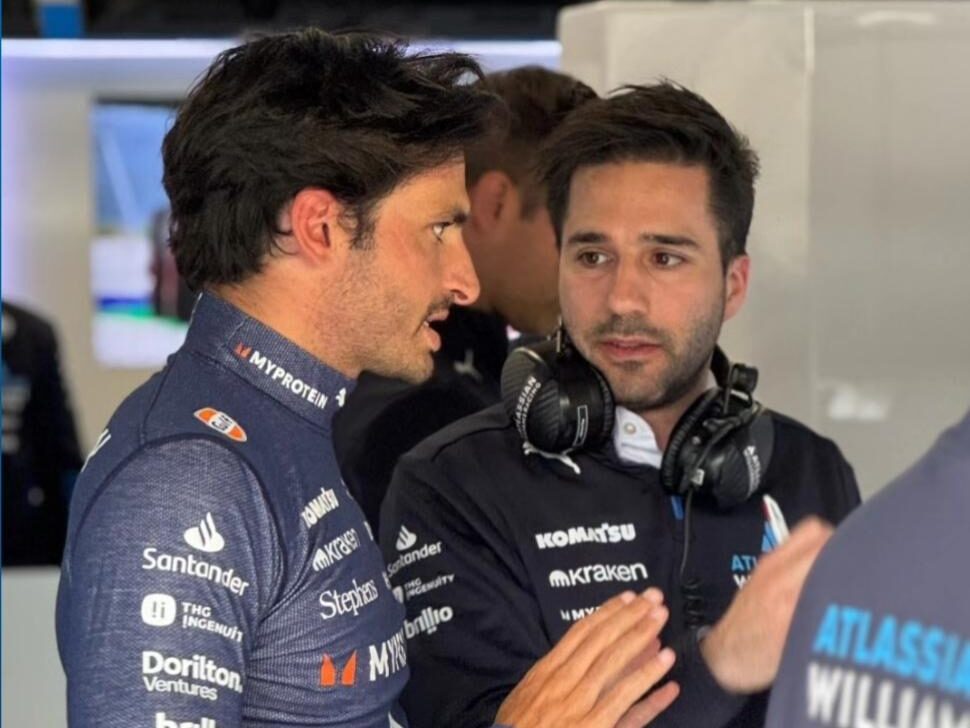

From Formula 2 and WEC success with Toyota to the Williams pit wall: Race and Performance Engineer Marco Fuga exclusively reveals the technological secrets of Formula 1, the psychological challenges faced by drivers, and the future of the new regulations.
The pit wall during a Formula 1 Grand Prix is a frantic ecosystem, where every second is marked by thousands of data points streaming across screens and decisions that can change the fate of a season. In this scenario, the engineer is the true glue between the driver’s raw talent and the mechanical complexity of the car.

Marco Fuga knows the pit wall like the back of his hand. From the tight battles of Formula 2 and the silent strategies of Formula E to the triumph at the 24 Hours of Le Mans with Toyota, his journey led him to be a fundamental piece of the Williams resurgence in Formula 1 throughout 2024 and 2025, before his return to Toyota at the beginning of 2026.
In this exclusive chat, Marco Fuga takes us behind the scenes of his work, analyzing what it truly means to manage champions like Carlos Sainz, rookies like Franco Colapinto, and the challenges of a Formula 1 that looks toward a future where the driver still counts for more than one might think.

Marco, you are a Race and Performance Engineer: can you explain your job to us in simple terms?
“The Race Engineer is the final link in the command chain. They speak with the driver and the chief mechanics, define the run plan in every detail, and have the final say on setup changes. The Performance Engineer is their wingman: they analyze data and manage electronic controls and the flow of information from other technicians (such as the System Engineer) before it reaches the Race Engineer.”
“In my 15-year career, I have almost always worked as a Race Engineer. I joined Williams to rotate between the two roles since there were three of us per car, but after a few months, they decided to stop this experiment. Gaëtan… [Jego] and James [Urwin], the two Race Engineers [of Carlos Sainz and Alex Albon, respectively], are extremely experienced, so they asked me to serve as the Performance Engineer full-time.”

“I entered Formula 1 relatively late compared to the average age of engineers, which is very low. Often, there are very young guys who have only ever done Formula 1. I brought with me a different background, coming from categories where you had to know how to do a bit of everything, and this helped me jump between the Race and Performance roles without too much difficulty.” .
Your first long-term international experience was in Formula 2 with Rapax from 2012 to 2017, where you worked with many talented drivers who, however, didn’t make it to Formula 1. What is sometimes missing?
“I’ve seen many stories. Tom Dillmann, for example, was one of the first I worked with: he was very mature, had already developed a great feel for the setup in Formula 3, and is now doing well in LMP2. Then there’s Johnny Cecotto Jr., who in my opinion absolutely had the numbers for Formula 1; he had positive tests, but it never materialized. Antonio Fuoco is another example: in WEC, he is proving to have an extra gear even compared to former Formula 1 drivers. The same goes for Stefano Coletti, Charles Pic, and Nyck De Vries.” .

“In Formula 2, it’s difficult to judge from the outside: it depends on how the team works in that specific year and who is involved. But I am convinced that, in the end, the true world champions always make the leap. If the top management sees a potential champion, the sponsors will be found. Kimi Antonelli is the perfect example: Mercedes saw his potential and followed him. Then, subjectively, there are drivers who deserve it more than others who are already there, but those who sign the contracts are looking for the superstar.” .
In 2018, you moved to Formula E with Dragon Racing: why does that category struggle to be perceived as a top-tier series?
“Because it’s difficult for the public to understand. In Formula 1, strategy is linear: tires, lap times. Formula E has become too complicated with energy management and Attack Mode. Furthermore, the cars all look the same. In reality, when I was there, there were huge differences in software, hardware, and rear suspensions, but they were invisible from the outside: the public only saw different colors on identical cars.” .

“In Formula 1, if you change a wing, everyone sees it, whereas there, everything was hidden. The environment, however, was great: races in city centers, a young target audience, and many families. And the level of both drivers and investments was, and still is, extremely high.”.
2021 arrives, and with it, the call from Toyota in the WEC: how does the preparation change for long-distance races?
“It changes a lot, perhaps more than one might think, because the goal is different. In Formula 1, you maximize the driver-car package for pure speed. In the WEC, you work heavily on operations and procedures. You have to know exactly what to do the moment something goes wrong. With Toyota, we won many races by managing problems that the public didn’t even know about, but that didn’t affect the outcome because we were all so well-prepared. In Formula 1, with 24 races, sometimes the preparation doesn’t reach those levels of detail due to a lack of time.” .

“At Le Mans, there are no shifts. They bring you food at the pit wall, and you only move to go to the bathroom two or three times in 24 hours. You can never let your guard down: if you don’t catch a slow puncture on a 13 km lap, you risk losing 5 minutes instead of 3.” .
Do you ever feel bored during a 24-hour race?
“Boredom, no, but the risk is a drop in attention during the quiet moments. In Formula 1, the 90 minutes of the race are incredibly intense; there is no room for anything else. In the WEC, there are phases where everything seems under control, and that’s exactly when mistakes happen. My job as a track engineer was also to manage the mood in the office and on the pit wall: I had to keep my colleagues’ and the driver’s attention high, perhaps by asking questions over the radio even if not strictly necessary, just to prevent anyone from mentally falling asleep.” .
“In Formula 1, due to a lack of time, preparation doesn’t reach the same levels of detail as in the WEC.” — Marco Fuga
In 2024, you then entered Formula 1 with Williams. In two seasons, you worked with Logan Sargeant, Franco Colapinto, and Carlos Sainz. How would you describe these drivers?
“They are drivers in different phases of their careers. Logan was very fast at times, but he suffered under the weight of Formula 1 and from having a teammate like Alex [Albon], who is truly strong. Sometimes Logan didn’t have exactly the same car as Alex because, with the cost cap, parts are limited; if you damage a floor, the new one might not be immediately available.” .
“All drivers at this level know how to turn the steering wheel and press the pedals, so Formula 1 becomes a psychological sport: if a driver is fast for three-quarters of the track but consistently makes a mistake, it’s not a technical limit but a mental one. It’s a psychological loop: if you don’t feel confident, you start overdriving, you make mistakes, and you enter a negative spiral.” .

“Franco arrived with the freshness of Formula 2. With him, we had to work on pure driving to help him understand the differences from his previous cars. He is a Latin driver, he is very sensitive to external factors, and Gaetan [his Race Engineer] did a great job acting as a shield against the incredible media pressure surrounding him.”
“Carlos is an extremely technical driver. He likes to get to the bottom of everything: setup, controls, team management. He has a very clear managerial vision—he will be an excellent manager if he chooses to be in the future. With him, you don’t work on his driving, but on optimizing the systems so that the car responds naturally to his inputs. Alex, then, remains a benchmark: Carlos did very well this year, but Alex ended the year with more points, proving just how strong he is.” .
“If he wants to, Carlos [Sainz] will be an excellent manager in the future.” — Marco Fuga
What was the biggest challenge in moving to Formula 1?
“Without a doubt, traffic management. It’s a part of the job that takes up a huge portion of a Race Engineer’s mental capacity during a session. You find yourself acting as a continuous, instantaneous filter for the driver, processing a massive amount of information coming in over the radio.” .
With the technology available in Formula 1 today, does the driver still carry a large percentage of responsibility for the result?
“Absolutely, yes, especially in the medium and long term. It’s not just a matter of how hard you press the pedal, but of the direction you provide for development. An experienced driver helps you understand if the simulator data matches reality. If the setup direction is right, the entire aerodynamic chain benefits. The driver is the one who closes the loop between the engineers’ calculations in the factory and the performance on track.” .

Why has Williams improved so much from 2024 to 2025?
“The car was already good last year, but the results came in a landslide in 2025 thanks to the maturation of many processes. The team has grown immensely; new analysis groups were created that made all the difference. We also benefited from the Mercedes rear suspension. It is a combination of small details that, on such a tight grid, allow for huge leaps forward.” .
What are your thoughts on the 2026 regulations?
“I haven’t been involved in the development of the new car, but my fear is that energy management will become too much of a protagonist. I wouldn’t want it to become a ‘cerebral’ type of driving like in Formula E , where the public doesn’t understand why someone is going slower. Formula 1 must remain a challenge of visible push and talent.” .
READ ALSO: Formula 1 officially enters a new era: here is everything you need to know!
What is life like in Formula 1, being constantly ‘on the road’ with 24 races a year?
“It’s a frantic life. In Formula 1, you live in a bubble: you arrive, go to the hotel, then to the track, and leave again. Often, you see nothing of the country hosting you. Compared to other championships like the WEC, where you might manage to grab a dinner or half a day to soak in the local atmosphere, the pace here is extreme. It’s a job fueled by passion: at 40, after nearly 20 years in the career, you feel the weight of the travel and the lack of a steady social routine, but that’s the price you pay to be at the pinnacle of motorsport.” .
To conclude, can you share some curious anecdotes from the paddock?
“We spend very little time with drivers from other teams: Formula 1 is very closed-off and the schedule is extremely tight, but there are some human moments. George Russell drops by to visit us every now and then, since he’s ‘family’ at Williams: once he came by with a child to get him Alex’s autograph.”

“And then there’s Franco: one evening I found out on Instagram that he was teasing me on DAZN Spain because I had appeared on camera that morning looking completely exhausted. Also with Franco, I remember between the Mexican and Brazilian GPs, during the debriefs in the garage, we could hear the chants of the fans calling his name from outside. At one point we told him: ‘Okay, the meeting is over, go to your fans!’. It’s a tough environment, but these guys remain professionals with a great deal of humanity.” .
Photo: Marco Fuga
