

Very consistent race pace for Antonelli and Russell, different programs for Ferrari.
During the night, the first weekend of the 2026 season got underway, marking the beginning of a new era for Formula 1. In the first free practice session, the fastest driver was Charles Leclerc, with Lewis Hamilton completing a Ferrari one-two that gave Italian fans plenty of hope. In the second free practice session, however, the best time was set by home favorite Oscar Piastri, just ahead of the Mercedes duo, with Antonelli ahead of Russell, and the Ferrari pair.
For this first round of the 2026 season, Pirelli—who recently announced the departure of Mario Isola starting from the Silverstone Grand Prix—has chosen to bring the softest compounds available: C3 (Hard), C4 (Medium), and C5 (Soft). The Italian manufacturer has confirmed the same selection used in the 2024 and 2025 editions, despite the 2026 tyres having a different configuration, with a reduced overall diameter.
As announced by Mario Isola to the microphones of Sky Sport F1 during FP2, the race is expected to be a one-stop race, although the last dry race here, in 2024, was won by Ferrari’s Carlos Sainz, who opted to start on medium tyres and then make two pit stops to switch to hard tyres.
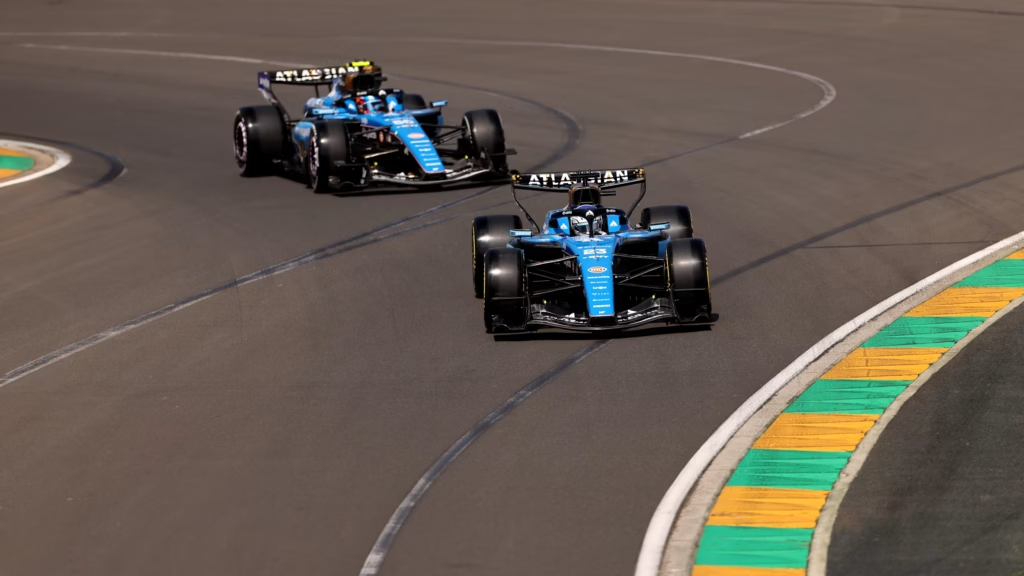
Finally, the 2025 edition was characterized by variable weather: in fact, a heavy downpour shortly before the race— which also led to the cancellation of the Formula 2 Feature Race— forced all the drivers to start on intermediate tyres. Around the middle of the race, there was a switch to dry tyres, but another sudden burst of rain once again turned the race upside down. 🌧️🏁
For the 2026 edition, however, according to what is reported by accuweather.com, rain should not play a major role. In fact, on Sunday the weather is expected to be partly sunny, while tomorrow the sky will be cloudy, with gusts of wind also expected.
Race pace analysis FP2 Australia: the lap times from this morning.
Mercedes was the first team to head out on track for a race simulation during this morning’s FP2, with Andrea Kimi Antonelli and George Russell opting to test the hardest compound. Ferrari and McLaren, on the other hand, chose a different program, carrying out another qualifying simulation before completing a long run in the final minutes of the session.
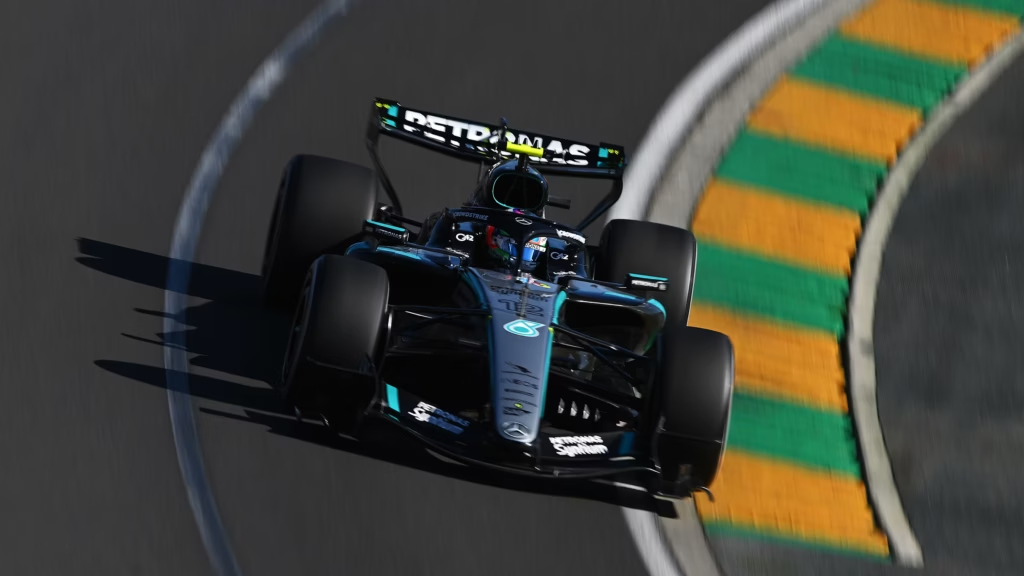
The most interesting race simulation was carried out by George Russell, who completed 11 laps on the Hard tyres without ever dropping below 1:24.5. Slightly slower, but still very significant, was Andrea Kimi Antonelli’s race simulation, with lap times consistently around 1:24. Both Mercedes drivers showed excellent car stability and reported no signs of tyre degradation or graining at the end of the stint.

A different program was followed by both McLaren drivers, who completed a short 5-lap long run on Soft tyres. The fastest lap of the race simulation was set by Lando Norris, the only driver to go under 1:23, but his times were fairly inconsistent despite the short stint. Oscar Piastri was slightly more consistent, though his lap times were about a second slower per lap than the Mercedes drivers, even though the fuel loads are, of course, not known.
The Ferrari drivers also chose a relatively short race simulation, carried out in the final minutes of the session. Therefore, the lap times are not very indicative, but a very positive sign is the consistency and stability, which is especially evident in Hamilton’s long run.
Finally, Max Verstappen also began a race simulation on Medium tyres, but the Dutch driver was forced to return to the pits after just 3 laps due to a spin between Turns 9 and 10, which resulted in damage to his RB22.


PHOTO: Mercedes-AMG Petronas F1 Team, GPKingdom.
