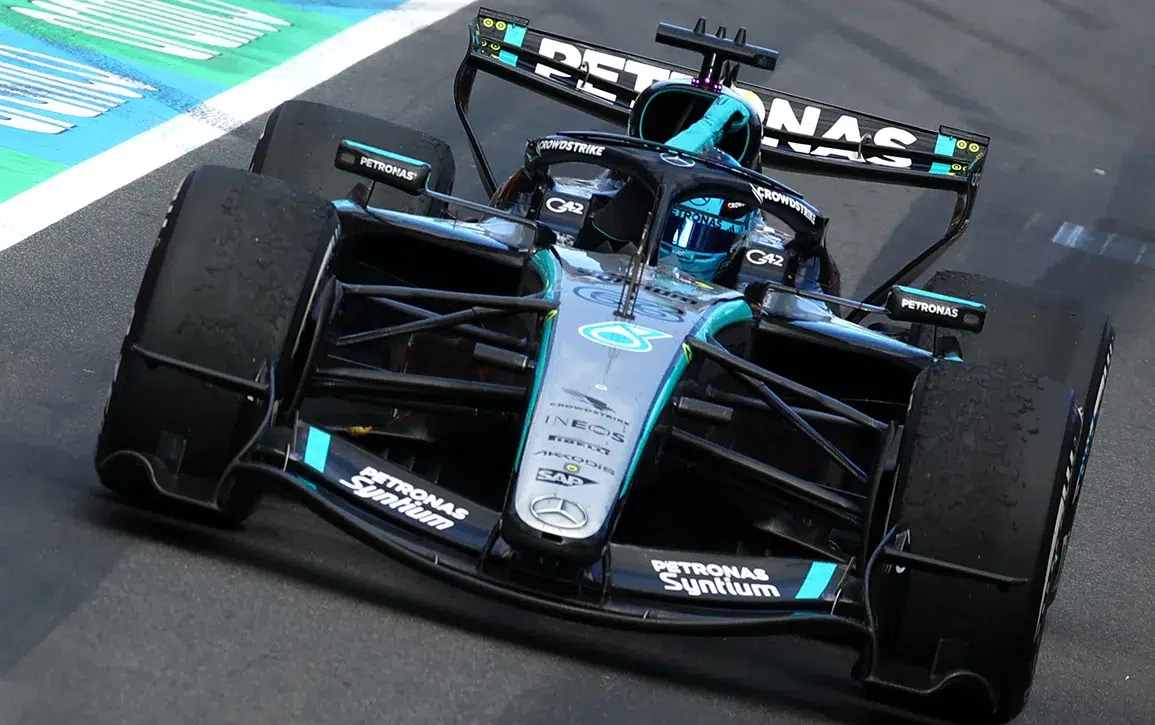

Mercedes’ dominance is closely linked to the Power Unit, but not only to the internal combustion engine: have the Brackley engineers recreated ‘party mode’?
The Australian GP, although more closely contested than expected in the early stages, was managed by Russell and Mercedes, just as had been widely predicted on the eve of the race. The new era of regulations has taken a strong turn in favor of the Brackley-based team, which—amidst controversies and off-track matters—has claimed the mantle as the leading force of 2026.
As previously mentioned, the race was less predictable than expected: Ferrari proved to be extremely strong at the start, shredding the competition and reaching Turn 1 with Leclerc in the lead (from third on the grid) and Hamilton in third (from seventh). Consequently, the first stint was a hard-fought battle to the end, featuring several duels among the leaders and a nearly identical pace, until the first Virtual Safety Car and the subsequent pit stops for Russell and Antonelli.

Strategy was a key factor in today’s race, as both Mercedes drivers managed to take advantage of the yellow flags to halve their time in the pits, gaining ground on Ferrari.
The gap was certainly present today, though not as evident as in yesterday’s qualifying. George Russell’s eight-tenths advantage over his closest pursuer was too large to represent the true performance delta and, indeed, that gap narrowed today. The fact that the distance between Mercedes and Ferrari was significantly smaller in the race than in qualifying suggests that the Silver Arrows are making better use of the Power Unit during Saturday’s sessions.
This qualifying superiority brings to mind the “party mode” used by Mercedes from 2014 to 2019.
What is party mode?
The qualifying mode used by Mercedes in F1 from 2014 to 2019 was a more aggressive engine mapping used only during qualifying sessions, which has been banned since 2020. Why, then, is there a suspicion that the Stuttgart-based team is using this specific setup? This is because FIA restrictions apply only to the internal combustion engine (ICE), not to the hybrid system. Even last year, in fact, teams were allowed to change the mapping of the electrical component of the Power Unit.

Mercedes’ qualifying advantage was clear during the 2019 season, epitomized by the Hungarian session where Lewis Hamilton dominated despite a very narrow superiority in the race. Their rivals pointed to this specific engine mode as the key to Mercedes’ dominance during those years, as they had few competitors in qualifying sessions.
George Russell and Kimi Antonelli held a massive advantage during yesterday’s qualifying, and this dominance seems to be directly linked to the management of the electrical system—now a fundamental element of the new Power Units. By supplying its engines to other teams, Mercedes gains a significant edge over the competition in software management for various components, allowing them to deploy more efficient mappings on track.
The only team that seems to have correctly interpreted the electrical power delivery so far, besides the championship leaders, is Red Bull. Since the start of testing, the Milton Keynes-based team was tipped as one of the best in developing the hybrid component, and yesterday’s qualifying session confirmed those feelings.
Telemetry Analysis

The telemetry comparing Russell’s and Leclerc’s qualifying laps is clear enough to understand the phenomenon: on all the straights, the Mercedes reaches higher top speeds despite an identical aerodynamic configuration (327 km/h against 318 km/h). Furthermore, it reaches the ‘super-clipping’ condition much later—the point at the end of the straight where, even with the throttle still wide open, the cars lose a significant amount of speed (about 40 km/h in the section between Turn 8 and Turn 9).
Even more emblematic is the section between Turn 10 and 11, following the long straight that leads into Albert Park’s magnificent S-section—a stretch where the electrical power is used to its fullest. In this sector, the Mercedes once again manages to reach much higher speeds than the ‘Rossa’, hitting ‘clipping’ much later.”
A much more effective management of the electrical system: perhaps, at least so far, this is the real key to Mercedes’ dominance. The much-discussed compression ratio has shifted the spotlight away from the other Power Unit component—the electrical part—which seems to be even more crucial than the internal combustion engine. Vasseur, however, appeared confident regarding China. Has Maranello perhaps found the key?
Photo: Mercedes-AMG Petronas F1 Team, GPKingdom
