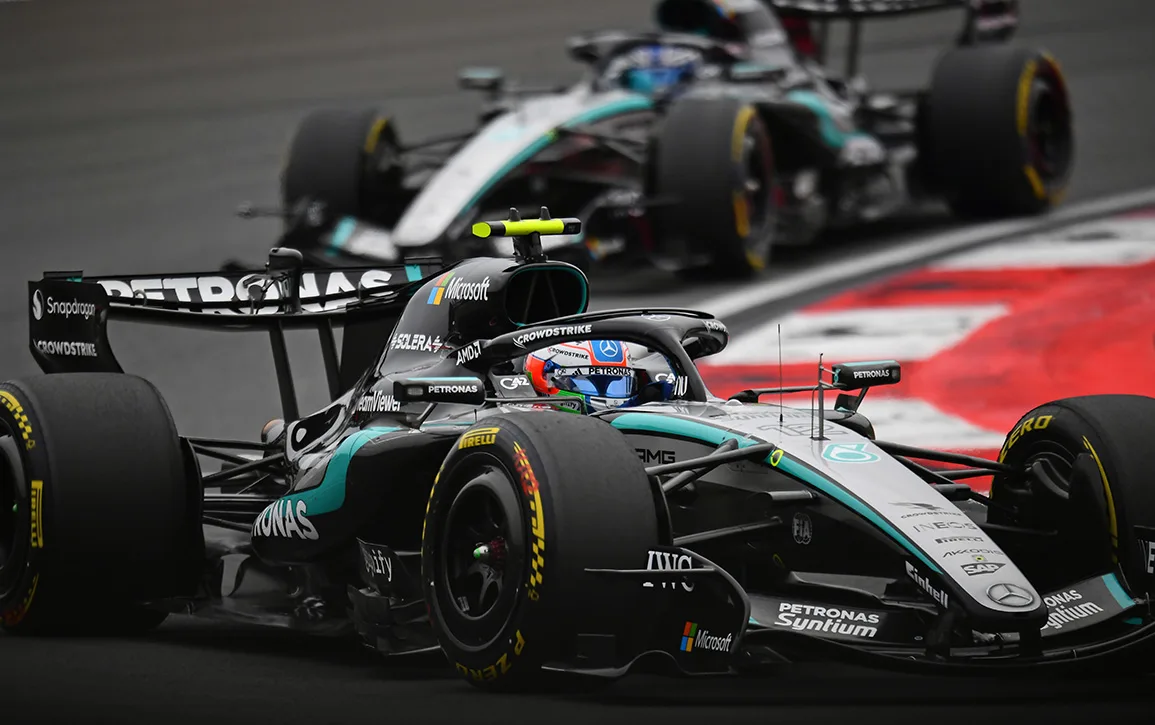

The Mercedes front wing has raised several doubts in the Formula 1 paddock, as it closed later than the allowed 0.4 seconds.
In recent hours, the spotlight of the Formula 1 circus has shifted back to the W16 of championship leader George Russell and Kimi Antonelli, fresh off his first career victory. After the controversy over the compression ratio earlier this year (which still persists), the Brackley team is under a new magnifying glass: the front wing.

This time, the focus is on the front wing’s active aerodynamics, specifically the transition time from “straight mode” to the cornering configuration. According to Article 3.10.10 of the FIA technical regulations, the maximum transition time between the two configurations is 0.4 seconds. During the Chinese weekend, the British car did not respect this parameter.
Also read: Suzuka: Who Benefits from the FIA Decision? Here’s What Changes for Qualifying
The Mercedes mobile device, in fact, had different closing phases. On the straight, the wing was completely flat, while during the braking phase, it took on two different configurations: an initial intermediate one at the start of braking, and a second, definitive one. The entire cycle exceeded the 400 milliseconds allowed by the regulations and could therefore be defined as irregular. For this same reason, Ferrari previously received a warning regarding the much-touted “Macarena wing,” which took longer than expected to complete its movement.
Nicholas Tombazis, the former Ferrari engineer and current FIA single-seater head, took note of the fact but did not consider it a deliberate act by Mercedes.
Conscious choice or simple calculation error?
Mercedes chose to use hydraulic pressure to change the state of its wings, and this was precisely why the team faced issues.

Once “corner mode” was activated, the W16 lacked enough pressure to push the wing from the flat position to the cornering one due to the high speeds on the straights, which created a greater sum of forces. As speed decreased, the ideal pressure returned, and the wing could revert to the base configuration—this is exactly why two phases were seen within the same braking zone.
The team noticed the problem during qualifying and tried to remedy it by changing the wing on George Russell’s car. This attempt was not enough to resolve the difficulties, as Kimi Antonelli also had to struggle with this issue during the race.
Did Mercedes’ “lagging” wing provide any advantages?
Since returning from the China weekend, Toto Wolff’s engineers have been working to fix the problem. They seem to have found the right solution, and the FIA has accepted the explanations provided by Mercedes, deciding not to penalize the team.

Despite this, several theories suggest Mercedes wanted to take advantage of this two-phase closure.
One theory revolves around ERS energy recovery. It was hypothesized that by closing the rear wing entirely while pausing the front wing’s closure, the team could not only give the driver a better feel but also guarantee better electrical recovery.
Another theory claims that by interrupting the transition, Mercedes managed to channel aerodynamic flows by exploiting “grey areas” of the regulations.
The truth is that Mercedes seems to have modified the car’s setup because what happened offered no advantage and was unintentional. Tombazis himself decided to “let it go,” stating that “there was no intent and it was not relevant.” As fascinating as the theories were, the reality points to a simple calculation error by Mercedes.
Photo: Mercedes-AMG Petronas F1 Team
