
From Owner-Drivers and Patrons to Engineering Leaders: Analyzing the Shift in Formula 1 Team Principal Roles
La Formula 1 sta vivendo una trasformazione silenziosa al vertice. Nel 2026, più di metà dei team principal in Formula 1 avrà un background da ingegnere. Questo rappresenta un cambio di paradigma rispetto al passato, quando il box era guidato da ex piloti-proprietari o manager puri.

The Budget Cap and increasingly complex regulations have shifted power towards those who understand numbers, CFD (Computational Fluid Dynamics), and technical regulations. When the next season kicks off, as many as six out of eleven team principals will be former trackside engineers, strategists, or technical directors promoted to lead their teams.
At McLaren, Andrea Stella has a background as a performance engineer at Ferrari and McLaren. The new Red Bull team principal, Laurent Mekies, began his Formula 1 career as a race engineer at Minardi. The man who replaced him at Racing Bulls, Alan Permane, started his career as an engineer in the late nineties at Enstone, which was then the home of Benetton, later rebranded as Renault, Lotus, and Alpine.

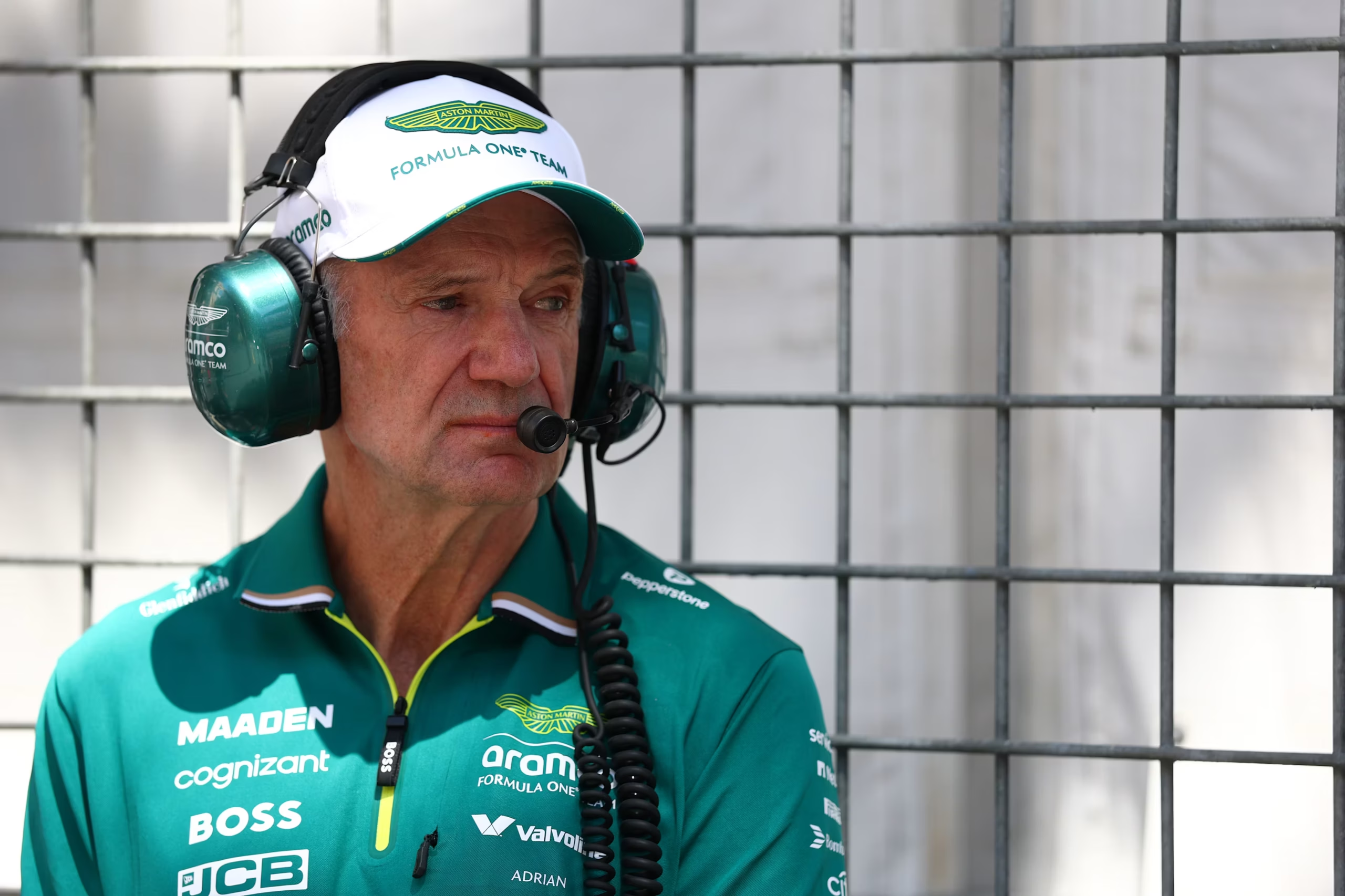
And how can we forget Adrian Newey, the greatest designer of all time, the mind and hand behind the victories of Williams, McLaren, and Red Bull? The news of the week concerns his appointment as Aston Martin Team Principal.
James Vowles, who is leading Williams’ recent growth, was Head of Strategy first at Brawn GP and then at Mercedes. Guenther Steiner’s successor at Haas, Ayao Komatsu, has an engineering history around the paddock, including BAR Honda, Renault, and Haas.
ALSO READ: BREAKING – Adrian Newey Named Aston Martin Team Principal! All the Details Here
Despite the growth of this trend for the past three seasons, up until 2024, the Constructors’ Championships of the recent past have been won by teams led by a manager: Jean Todt and Stefano Domenicali at Ferrari, Christian Horner at Red Bull, and Toto Wolff at Mercedes. The one exception is the Brawn GP fairy tale in 2009, led by former Ferrari engineer Ross Brawn.
This new model undoubtedly has advantages: more informed decisions, a short technical chain of command, better dialogue with the FIA and designers, especially in light of the 2026 regulation change.

However, there are also risks: less room for the political and human management of the team, and more responsibility concentrated in a single figure. Let us not forget, for example, the Binotto era at Ferrari. A brilliant engine engineer at the time, behind the successes of Schumacher and Räikkönen, his years as Team Principal can instead be viewed as a failure. The missed 2022 title, due to strategic and management errors, exposed his managerial shortcomings compared to his predecessor Arrivabene, who, although also without titles, led the Prancing Horse (Ferrari) with greater personality.
To address this, some teams have already moved to organize their leadership into a CEO/Team Principal pairing, specifically with the goal of balancing technical expertise, politics, and business.
ALSO READ: Verstappen on Team Orders at McLaren: “Let them race”
The most striking and successful example is McLaren, the recent winner of the last two Constructors’ Championships, which sees Andrea Stella as Team Principal and Zak Brown as CEO, equally (and uniquely, considering the other teams on the grid) involved in the daily management of the team. This pairing aims to leverage Stella’s on-the-ground technical expertise, delegating the (often overloaded) managerial duties to a distinct yet aligned figure.
Photos: Formula 1
